




Bitget’s tokenized Nvidia perpetual market has reached roughly 75% of the liquidity depth of the exchange’s Bitcoin spot market, according to a new joint report from Bitget and analytics firm Block Scholes.
Summary
- Bitget and Block Scholes found NVDA linked perpetuals reached about $4.1 million in liquidity depth, roughly 75% of the exchange’s Bitcoin spot market.
- Liquidity across Bitget’s tokenized stock and commodity markets improved through 2026, with tighter spreads and deeper order books reported across major contracts.
- Trading conditions remained functional during the early stages of the U.S. Iran conflict, with spreads recovering quickly and market depth returning to typical levels within days.
According to the report shared with crypto.news, liquidity across Bitget’s tokenized real-world asset perpetual futures has strengthened through 2026, with several equity and commodity-linked contracts showing tighter spreads, deeper order books, and faster recovery during periods of market stress.
The study examined four of Bitget’s largest tokenized perpetual contracts, NVDA-USDT, SPY-USDT, QQQ-USDT, and XAU-USDT, which provide synthetic exposure to Nvidia stock, the SPDR S&P 500 ETF, the Invesco QQQ ETF, and gold through crypto-based trading infrastructure.
By mid-May, data from Bitget showed NVDA-USDT had reached approximately $4.1 million in resting liquidity within 2% of its mid-price. For comparison, a CoinGecko snapshot cited in the report placed Bitget’s BTC/USDT spot market depth at around $5.5 million, leaving the Nvidia-linked contract with about three-quarters of the liquidity available in Bitcoin’s spot market.
“Access alone is no longer enough and the conversation around tokenization has moved beyond access. What matters now is whether users can move capital efficiently between markets without sacrificing liquidity. Whether someone is trading crypto, equities, gold, or tokenized assets, they expect the same depth and speed.” – Gracy Chen, CEO of Bitget.
Liquidity deepens as tokenized markets expand
Since launching equity-linked perpetual futures in September 2025, Bitget has expanded its offering to more than 30 stock-related contracts alongside commodity products such as gold-linked perpetuals, the report said.
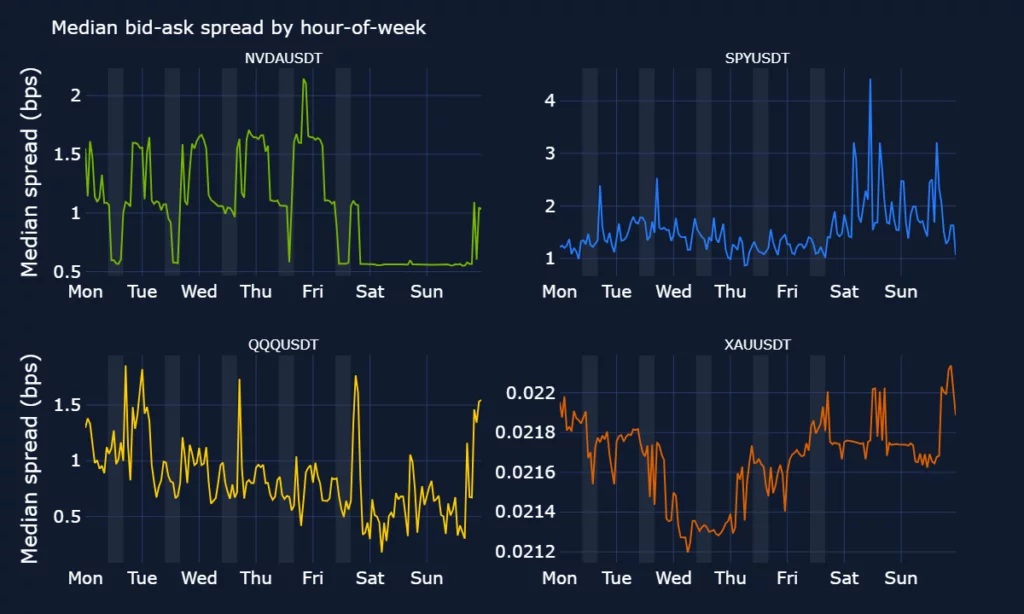
Researchers found liquidity conditions improved as U.S. trading hours progressed. During one observation period on May 18, SPY-USDT’s bid-ask spread narrowed from 1.76 basis points shortly after the U.S. market opened to 0.14 basis points less than an hour later. Gold contracts maintained the narrowest spreads, reaching as low as 0.02 basis points in sampled data.
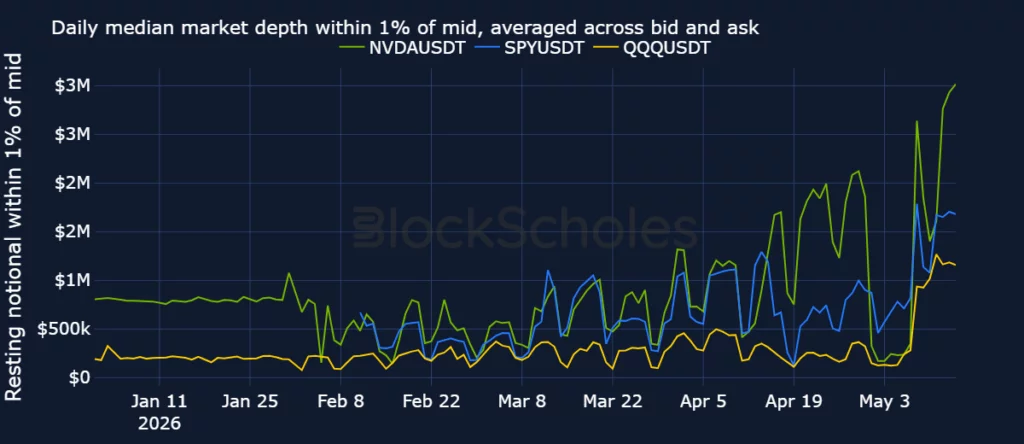
Order book depth also increased steadily during the first months of 2026. Block Scholes noted that NVDA-USDT consistently carried the deepest order book among the equity-linked contracts studied.
The findings arrive as tokenized securities continue attracting capital across the digital asset sector. Earlier this month, Binance Research reported that the tokenized real-world asset market had grown 589% since early 2025, while tokenized stocks recorded a 422% increase in value, making them the fastest-growing segment in the sector.
Binance Research also highlighted an uptick in activity from platforms such as Ondo Global Markets, which surpassed $1 billion in total value locked through tokenized stock and ETF products, while trading volume across the xStocks ecosystem exceeded $25 billion.
Market resilience during geopolitical tensions
Beyond normal trading conditions, the report evaluated how Bitget’s tokenized markets responded when the U.S.-Iran conflict began in February 2026.
Data cited by Block Scholes showed bid-ask spreads widened immediately after news of the conflict emerged. NVDA-USDT spreads increased from about 0.6 basis points to a peak of 3.4 basis points, while QQQ-USDT spreads rose from 3.7 basis points to 11.8 basis points.
Despite the initial reaction, spreads returned close to pre-event levels within minutes or hours depending on the contract. Order book depth declined more noticeably, with QQQ-USDT, SPY-USDT, and NVDA-USDT all recording lower liquidity levels on Feb. 28.
Analysis in the report found the decline extended beyond the usual weekend reduction in trading activity. Still, liquidity conditions recovered quickly. QQQ-USDT depth returned to typical Saturday levels within a week and remained stable afterward.
Gold recorded the strongest response among the assets studied. The report said XAU-USDT rose about 2% following the conflict announcement and generated approximately $11 million in trading volume, compared with about $400,000 for NVDA-USDT over the same period.
Block Scholes concluded that liquidity in Bitget’s tokenized perpetual markets remains linked to traditional market activity but continues functioning outside regular trading hours, with spreads staying relatively tight and order books recovering quickly after periods of heightened volatility.
