


A wave of Solana memecoins carrying the name of influencer Ansem has gone parabolic, with one version running to tens of millions in market cap in under two weeks. But Ansem did not create most of them, has publicly disavowed several, and the eye-catching pump figures often do not survive a look at the chain. Here is what $ANSEM actually is, why it is trending, and what it teaches about influencer coins.
Summary
- $ANSEM is not a single coin but a cluster of competing Solana memecoins built around the online identity of crypto influencer Ansem, real name reported as Zion Thomas, who created none of them.
- The dominant “Black Bull” version on Pump.fun ran from a market cap in the tens of thousands to tens of millions of dollars within roughly 10 to 12 days in mid-to-late June 2026.
- Ansem amplified the frenzy by criticizing the launchpad Pump.fun and pledging to airdrop his creator fees to the community, while at the same time disavowing other $ANSEM tokens as impersonations.
- Several viral pump figures circulating on aggregator trackers did not hold up against live on-chain data, a reminder to verify the actual contract before trusting a headline number.
- $ANSEM is best understood not as a coin to buy but as a live case study in how an influencer’s name spawns a swarm of speculative and copycat tokens, and how easily retail buyers get hurt.
$ANSEM is the name shared by a cluster of competing Solana memecoins that sprang up around the online identity of the crypto influencer known as Ansem, whose real name is reported as Zion Thomas and whose verified account is @blknoiz06, and the single most important fact about it is that Ansem did not create these tokens and has publicly distanced himself from several of them. That makes $ANSEM less a single coin than a phenomenon: a recognizable name in crypto that, the moment it started trending, spawned a swarm of tokens using it, some promoted heavily, some outright impersonations, and no single official one among them. In late June 2026, one version branded as “The Black Bull” went parabolic on the launchpad Pump.fun, climbing from a market cap in the tens of thousands of dollars to tens of millions within roughly 10 to 12 days, while traders fought in what the culture calls the trenches over which $ANSEM coin, if any, was the real one. The story drew enormous attention, and it is a near-perfect illustration of how influencer memecoins actually work, who tends to benefit, and who tends to get hurt.
This guide treats $ANSEM the way it deserves to be treated: not as a coin to evaluate buying, but as a case study to learn from. Understanding it requires understanding who Ansem is and why his name carries weight, why there is no single official $ANSEM coin, how the frenzy unfolded and what catalyzed it, the disavowal and the copycats that complicate the story, the creator-fee twist that made it unusual, the gap between viral pump figures and on-chain reality, and the genuine risks that influencer memecoins carry for the people who chase them. The aim is that by the end, a reader could recognize the pattern the next time a famous name starts trending and a wall of tokens appears using it, because that pattern repeats constantly, and $ANSEM is simply its latest and loudest example. The lesson is in the mechanics, not the ticker.
Who Ansem actually is
To understand why a memecoin built on his name could run so far so fast, you have to understand the standing Ansem holds in crypto. Zion Thomas, who goes by Ansem and is sometimes called “The Solana Guy,” is one of the most-followed voices in the space, with roughly a million followers on the platform X. His reputation rests on a real track record: he was an early and vocal supporter of Solana and of memecoins like Dogwifhat and Bonk, and he is widely credited with calling Solana’s enormous 2023 rally, when the token climbed from around $8 to nearly $300. He has a background in computer science from Georgia Tech and worked as a software engineer before moving into crypto full time, and he holds a research role at an investment firm.

That combination of early correct calls, technical credibility, and a massive audience is why his name carries weight, and why a token attached to it can attract a flood of speculative buying on attention alone. But the picture is not uniformly flattering, and an honest explainer has to include the criticism, because it is directly relevant to the risks of any coin bearing his name. Ansem has drawn sustained accusations that he uses his influence to promote low-cap memecoins that spike and then collapse. In late 2024, the prominent on-chain investigator ZachXBT publicly accused him of promoting micro-cap coins in a way that resembled pump-and-dump dynamics, hyping risky tokens to a large following, watching them briefly surge, and leaving late buyers with losses.
These remain accusations rather than proven findings, and Ansem has his defenders, but the pattern they describe is exactly the danger retail buyers face with influencer coins. Notably, Ansem himself has at times acknowledged the problem: he has publicly admitted that supporting some celebrity-backed memecoins was a mistake, citing misaligned incentives that hurt retail investors. That admission is worth holding onto, because it comes from the very person whose name is now attached to a fresh memecoin frenzy, and it captures the core risk better than any outside critic could. In influencer memecoins, the audience is often the liquidity, and the audience is usually the last to understand that.
There is no single $ANSEM coin
The most common and costly misunderstanding about $ANSEM is the assumption that it refers to one coin. It does not. When Ansem’s name began trending, multiple distinct Solana tokens using the $ANSEM name appeared at the same time, and there is no single official one that Ansem created or endorsed as the canonical version. This is not unusual; it is the standard sequence in crypto. A well-known name starts trending, and within minutes a swarm of tokens appears using it, deployed by different anonymous creators all hoping their version becomes the one the market settles on.
The result was a chaotic competition, with the trading community flipping between rival $ANSEM coins and no clear winner crowned as the real one for a stretch, a dynamic participants describe as a player-versus-player battle in the trenches. Out of that scramble, one version did come to dominate the narrative: a coin branded as “The Black Bull,” launched on the Pump.fun launchpad in mid-June 2026, which became the token most associated with the headlines as it ran to tens of millions in market cap. Even so, the existence of that dominant version does not change the underlying reality that the name was contested and that other $ANSEM tokens continued to circulate alongside it, including ones Ansem explicitly disavowed. For anyone encountering the trend, the practical implication is severe: there is no safe assumption that a token labeled $ANSEM is the one being discussed, is endorsed by Ansem, or is anything other than an opportunistic deployment by a stranger.
The name on the token tells you almost nothing about who made it or whether it is connected to the person it references. That single fact, that the name is not the coin, is the first and most important thing to internalize about $ANSEM and about every influencer memecoin like it. This is whyverifying contracts and accounts matters before believing any viral ticker. A famous name can become a trap when anyone can attach it to a contract.
How the frenzy unfolded
The timeline of the $ANSEM surge shows how quickly attention converts into market cap in this corner of crypto, and what lit the fuse. The dominant Black Bull version gained real traction around the middle of June 2026 and then, over roughly 10 to 12 days, went parabolic, rising from a starting market cap reportedly in the tens of thousands of dollars to a level above $50 million and then $60 million at its peak, accompanied by gains measured in thousands of %. On-chain trackers recorded enormous short-window moves, with one tracker reporting a single-day surge of well over a hundredfold at one point, the kind of move that draws the entire trading community’s attention and pulls in waves of new buyers chasing the run.
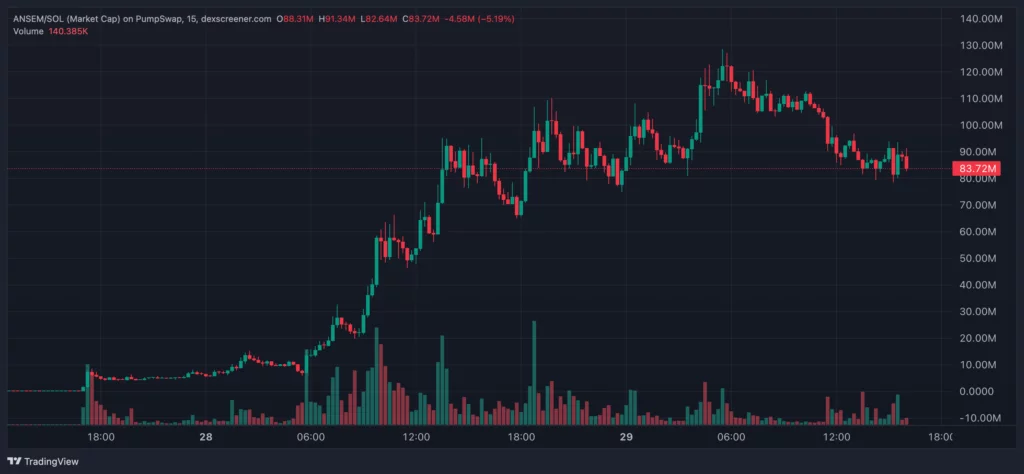
A specific catalyst supercharged the move. Ansem publicly criticized Pump.fun over how it handled rewards to users, and declared that he would deliver a financial boost directly to retail traders, a gesture he framed in the community’s own language. In a widely shared post on June 28, 2026, he wrote that he “had to give the trenches a stimmy since pump refuses to,” using slang for handing money to on-chain traders. That narrative, an influencer taking the side of small traders against the platform, spread rapidly across crypto social media and triggered a fresh wave of speculative buying that lifted the token’s valuation further.
The frenzy also minted dramatic individual outcomes that became their own marketing: in one widely reported case, a trader who put roughly $2,300 into an ANSEM-named token saw the position balloon to more than $600,000 after a parabolic rally, a return of tens of thousands of %. Stories like that, true but extraordinarily rare, are exactly what pull more people into the next frenzy, which is why they deserve to be read with as much caution as excitement. The setup also show how the launch pricing worked, because these early Solana memecoin moves often begin on bonding curves before attention pushes them toward graduation or collapse. The bigger the screenshot gain, the more important it becomes to ask who bought before the crowd and who is left buying after the move.
The disavowal and the copycats
Running directly against the bullish narrative is a fact that anyone tempted by $ANSEM needs front and center: Ansem publicly disavowed tokens trading on his name. According to posts reported from his verified account, he distanced himself from the activity, indicating that the coin being promoted was not him and that he was not endorsing any micro-cap tokens, and he clarified that he had only linked his account to a launchpad address to prove that he could, not to bless any particular coin. In other words, the person whose name was driving tens of millions of dollars in speculative value was, at the same time, telling people he had not created these tokens and was not endorsing them. That is a glaring contradiction at the heart of the trend, and it is the single clearest warning sign attached to it.
The disavowal points to the deeper pattern, which is the real lesson of $ANSEM. A recognizable crypto name reliably spawns a cluster of copycat and impersonation tokens, the overwhelming majority of which the named person never touched, because on a permissionless launchpad anyone can deploy a token and call it whatever they want. The Ansem case is a textbook instance: a swarm of $ANSEM tokens, no official one, and the real Ansem distancing himself from the activity even as it raged. The danger goes beyond merely buying the wrong version.
Ansem’s identity has been abused by outright impersonators before; reports describe a 2024 impersonation that phished roughly $2.5 million from victims, an event that had nothing to do with Ansem himself but used his name and likeness to steal. The takeaway is blunt: when a name is trending, impersonation and copycatting are not edge cases but the norm, and a token carrying a famous name should be treated as unaffiliated and unsafe until proven otherwise, a standard that becomes absolute when the person has publicly disavowed it, as Ansem did. The same pattern has appeared around other high-profile names and brands, including fake tokens designed to mimic official launches. That is why the first question should never be “how much is it up?” but “who actually created this contract?”
The creator-fee twist that made it unusual
One feature did set the $ANSEM episode apart from the typical influencer-coin story and helps explain both its momentum and the debate around it. Rather than simply launching his own token to capture the speculative interest, which is the usual influencer playbook, Ansem leaned into a different mechanic tied to how the Pump.fun launchpad pays out fees. Pump.fun routes a share of trading fees to a token’s associated creator account, and screenshots of Ansem’s launchpad profile indicated he had accumulated substantial creator fees, reported in the area of several hundred thousand dollars. In response to community suggestions, he announced that, instead of pocketing those fees, he would airdrop portions of them back to the community of traders, framing it as giving the trenches the boost the platform would not.
This redistribution, returning earned fees to holders rather than extracting and exiting, was received notably well in a culture used to influencers benefiting at retail’s expense, and it reinforced the narrative that Ansem had “skin in the game.” Indeed, reporting on his launchpad wallet suggested a very large exposure to the token, with a holding worth tens of millions of dollars making up the overwhelming majority of that wallet’s value. Supporters read this as alignment: the influencer profiting only if holders profit. Skeptics read it differently, noting that a huge personal position and a fee-airdrop program are also powerful tools for sustaining hype around a token the influencer benefits from, and that the same dynamics ZachXBT criticized, an influencer’s attention inflating a coin’s price, are present whether or not fees are shared.
Both readings can be true at once. The creator-fee twist made $ANSEM a more interesting and arguably more community-friendly episode than the average influencer coin, but it did not remove the underlying risk that the value rests on one person’s attention and could evaporate the moment that attention moves on. For context, the fee airdrop at the center of it belongs to a broader memecoin-launchpad incentive system where creators can earn from trading activity. Fee sharing can create alignment, but it can also keep attention locked on a coin long enough for others to exit.
The gap between the pump figures and the chain
A practical skill that the $ANSEM episode teaches, and one worth far more than any single trade, is the habit of checking on-chain reality against viral headline numbers, because the two frequently diverge. Some of the most eye-catching figures circulating during the frenzy, such as a roughly 1,900% single-day gain alongside a multi-million-dollar market cap, came from aggregator trackers and did not hold up when checked against live blockchain data. In at least one case, the token most associated with a headline pump turned out, on inspection, to be a coin dating to 2024 that had retraced to a market cap of only tens of thousands of dollars, with thin liquidity and minimal daily volume, a brief pump and fade instead of a sustained multi-million-dollar coin. Public data even dated that token’s all-time high to early 2024, which sat oddly with a supposedly brand-new 2026 surge.
The lesson is concrete and repeatable: never take an aggregator pump figure at face value without finding and verifying the actual contract address and reading the token’s real holder and liquidity profile. Aggregator trackers can display figures for tokens that are barely traded, can attach a trending name to the wrong contract, and can report point-in-time spikes that have already collapsed by the time a reader sees them. The discipline that protects you is to identify the specific contract, confirm it against the real person’s verified account where relevant, and screen it for safety using on-chain tools before believing any number attached to it. On Solana, traders commonly use a token-safety screener and a dedicated risk checker to read holder distribution, liquidity depth, and contract red flags before acting.
This habit, verifying the chain instead of trusting the headline, is the single most valuable thing the $ANSEM frenzy can teach, because it applies to every trending name that will follow. The same lesson appears whenever scammers reuse well-known names, whether they imitate a celebrity, a protocol, or a market-data brand. A ticker is not identity, and a chart is not verification. The chain is where the claim has to survive.
A worked example: telling the real from the fakes
To make the lesson usable, walk through how a careful person would have navigated the $ANSEM trend in real time, because the same steps apply to any influencer-name frenzy. Suppose you see the name $ANSEM trending and a post claiming a particular token is the official Ansem coin, up thousands of %. The first step is to assume nothing: a trending name attached to a token is, by default, unaffiliated until proven otherwise. The second step is to find the actual contract address being promoted, not just the ticker, since dozens of tokens can share the name $ANSEM while having entirely different contracts.
The third step is to check the real person’s verified account directly. In this case, doing so would have surfaced Ansem’s own posts distancing himself from tokens trading on his name and stating he was not endorsing micro-caps, which is a decisive red flag against treating any of them as official. The fourth step is to screen the specific contract on a Solana safety tool, reading the holder distribution, the liquidity, and any contract warnings. A token where a tiny number of wallets hold most of the supply, or where liquidity is thin, is one where a few holders can crash the price at will.
The fifth step is to compare the on-chain figures with the viral claim; if the chain shows a token that has already retraced to a fraction of the headline market cap, the claim is stale or misleading. Running these steps during the $ANSEM frenzy would have revealed exactly the situation this guide describes: multiple competing tokens, no official one, a disavowal from the named person, and headline figures that the chain did not support. The point of the exercise is not that doing this guarantees a profitable trade; it is that it protects you from the most common and costly mistakes, which are buying an impersonation, chasing a stale pump, or trusting a famous name as if it were due diligence.
The worked example is really a checklist for skepticism, and skepticism is the only durable edge in this part of crypto. When a token’s story rests on a famous name, the burden of proof should be higher, not lower. If the contract, liquidity, holder distribution, and verified account do not line up, the safest conclusion is that the coin is not what the crowd says it is. That is especially true when the person whose name is being used has already denied involvement.
Risks: why a name is not a reason to buy
Stepping back, $ANSEM concentrates nearly every risk that makes influencer memecoins dangerous, and naming them plainly is the most useful thing this guide can do. The first is extreme volatility: tokens like this can rise thousands of % and fall just as fast, and a coin that is up a hundredfold one day can be down 90% the next, with most such tokens ultimately trending toward zero. The second is the copycat and impersonation problem already described, where the name on a token tells you nothing about who made it, and where buying the wrong contract or an outright scam is a constant hazard. The third is the disavowal itself: when the person a coin is named after publicly states it is not theirs and that they do not endorse it, that is not a detail to trade around but a signal that the coin’s entire premise is unsupported.
The fourth risk is the pump-and-dump dynamic that critics, including ZachXBT, have attributed to influencer-driven micro-caps, where attention inflates a price that collapses when the attention moves on, leaving late buyers holding losses, a pattern Ansem himself has acknowledged can hurt retail. The fifth is the absence of any fundamental value: these tokens have no product, no cash flow, and no utility; their price is pure attention and speculation, which makes them closer to gambling than investing. That is also the scam pattern to watch for in celebrity or influencer-linked micro-caps, even when the token does not follow a classic liquidity-drain rug. The underlying danger is that attention becomes the product and late buyers become the exit.
The honest framing, which the responsible sources on this episode share, is that there is no official Ansem coin to buy, that any token using the name should be assumed unaffiliated until proven otherwise, and that chasing a celebrity name on vibes alone is among the fastest ways to lose money in crypto. None of this is a judgment of Ansem personally, who has at times warned about these very dynamics; it is a description of how the mechanism works and whom it tends to harm. The name is the bait. It is not, and never is, a reason to buy.
Frequently asked questions
Is there an official $ANSEM coin?
No. There is no single official $ANSEM coin created or canonically endorsed by Ansem. When his name began trending, multiple distinct Solana tokens using the $ANSEM name appeared at once, deployed by different anonymous creators, and Ansem publicly distanced himself from tokens trading on his name, indicating he was not endorsing micro-caps. One version branded “The Black Bull” came to dominate the headlines after running to tens of millions in market cap, but its prominence does not make it official, and other $ANSEM tokens, including impersonations, circulated alongside it. The safe assumption is that any token using the name is unaffiliated until proven otherwise.
Who is Ansem?
Ansem, whose real name is reported as Zion Thomas, is a prominent crypto influencer with roughly a million followers on X, sometimes called “The Solana Guy.” He has a computer science background and a research role at an investment firm, and he built his reputation as an early supporter of Solana and memecoins, widely credited with calling Solana’s 2023 rally from around $8 to nearly $300. He is also a controversial figure: the investigator ZachXBT accused him in 2024 of promoting low-cap memecoins in a pump-and-dump-like pattern, and Ansem has himself admitted that supporting some celebrity-backed memecoins was a mistake due to misaligned incentives that hurt retail investors.
Why is $ANSEM trending?
A combination of factors. Ansem’s name carries weight after years of influence and a famous correct call on Solana, so tokens using it attract attention automatically. The frenzy accelerated when he publicly criticized the launchpad Pump.fun over its handling of rewards and pledged to airdrop his accumulated creator fees back to traders, framing it as giving the community a boost the platform would not. That narrative spread quickly, dramatic individual gains became their own marketing, and the dominant version ran to tens of millions in market cap. The trend sits within a broader meta of influencer-linked memecoins on Solana, where a famous name plus social momentum can move a token enormously in days.
How do I avoid buying a fake influencer coin?
Treat any token bearing a famous name as unaffiliated until proven otherwise. Find the specific contract address being promoted, not just the ticker, since many tokens can share a name. Check the real person’s verified account for whether they actually launched or endorsed it; a disavowal, as with Ansem, is a decisive red flag. Screen the contract on a Solana safety tool to read holder distribution and liquidity, watching for a tiny number of wallets holding most of the supply or thin liquidity. Compare on-chain figures against viral claims, since aggregator pump numbers often do not match reality.Never treat a celebrity name as a substitute for verification. Famous names are exactly what scammers and opportunistic deployers use because they create instant attention. The safest first assumption is that the token is not official unless the person or project proves otherwise from a verified channel. Even then, the contract itself still needs to be checked.
Is $ANSEM a good investment?
This guide does not recommend buying it or any memecoin, and the honest answer is that $ANSEM carries the full set of risks that make influencer memecoins dangerous. It has no product, cash flow, or utility; its price is pure attention and speculation. It is extremely volatile, with most such tokens trending toward zero. There is no official version, copycats and impersonations are rampant, and the named influencer publicly disavowed tokens using his name.Critics have described influencer micro-caps like this as prone to pump-and-dump dynamics that harm late buyers. Treat any participation as high-risk speculation closer to gambling than investing, and never risk money you cannot afford to lose. The educational value of $ANSEM is not that it offers a clean trade, but that it shows how influencer-name tokens form, spread, and hurt careless buyers.
This article is educational information, not financial advice or an endorsement of any token. Details about $ANSEM, Ansem, market caps, and on-chain figures reflect reporting available as of June 29, 2026, are point-in-time, and can change rapidly. Memecoins are extremely high-risk and frequently lose most or all of their value. References to individuals reflect reported information and, where noted, unproven allegations. Verify any contract independently and consult a qualified professional before making any decision.
