




Disclosure: This article does not represent investment advice. The content and materials featured on this page are for educational purposes only.
WhiteBIT’s WBT surges 3,337% in three years, hitting $65.30 from a $1.90 launch price.
Summary
- WhiteBIT’s WBT surges from $1.9 in 2022 to $65.30, marking a 3,337% rise in three years.
- WBT powers WhiteBIT’s ecosystem, offering fee discounts, staking perks, and weekly token burns to cut supply.
- WBT joins five S&P Crypto indices, signaling growing institutional recognition of exchange-based tokens.
WhiteBIT launched its native token WBT in August 2022 at around $1.9. Three years later, it touched an all-time high of $65.30 — a roughly 3,337% gain from its low — making it one of the top-performing exchange tokens in the market.
The numbers tell the story
WBT bottomed at around $3 in September 2022, just weeks after launch. It spent most of 2023 quietly grinding between $3 and $6. Nothing flashy. By the end of 2023, it closed the year at $5.78. A slow start by crypto standards.
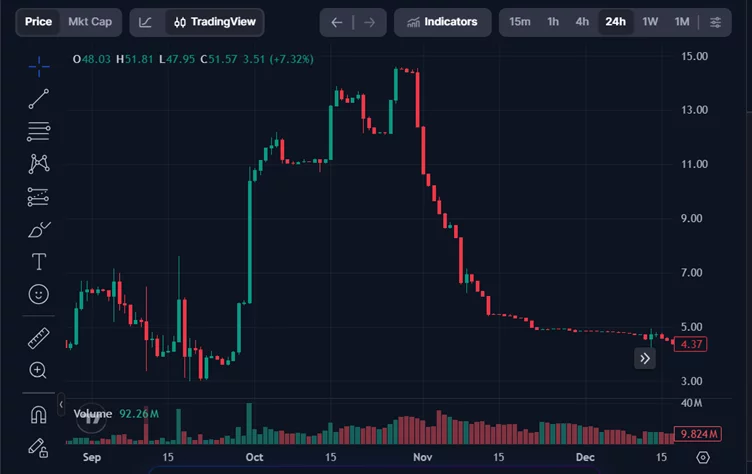
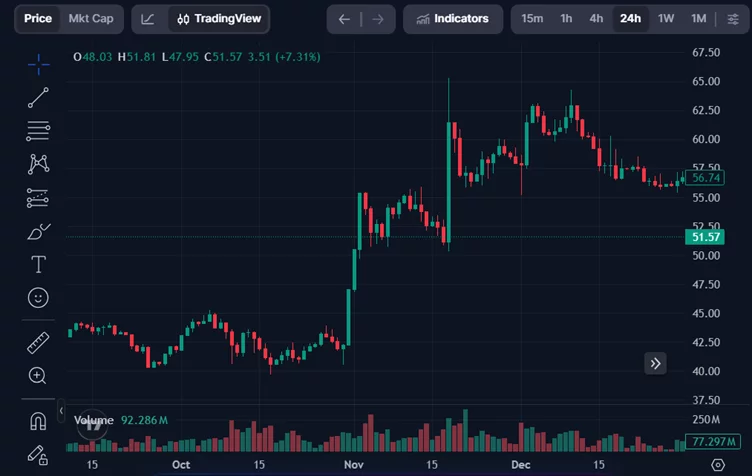
Then came 2024. The token climbed steadily to close the year at around $24.61, roughly a 4x from where it started the year. And 2025 is where things really accelerated. WBT went past $30, then $40, then $50, eventually hitting $65.30 on November 18, 2025, according to CoinMarketCap. As of February 2026, it’s consolidating around $50, sitting at a market cap above $10 billion and ranking among the top 15 globally.
What’s actually driving it
WBT is not a standalone token. It’s the native coin of WhiteBIT, one of the largest European crypto exchanges by traffic. The exchange was founded in 2018 and serves 8 million customers. It’s also a part of the W Group, which serves 35 million customers globally, and reached a total capitalization of $38.9 billion in 2025.
WBT’s utility is embedded in the platform. It is said that holders of WBT get up to 90% off taker fees, up to 100% off maker fees, free daily ERC 20 and ETH withdrawals, free AML checks, boosted referral rates up to 50%, access to staking rewards, VIP status, and access to the Earn program.
WBT has a maximum token number of 400 million. On top of that, the exchange runs a weekly token burn mechanism, creating a deflationary pressure that reduces circulating supply over time. As of early 2026, about 214 million tokens are in circulation.
Most notably, WBT was added to 5 S&P Crypto indices, underscoring the platform’s expanding influence in the global digital asset market and highlighting a broader industry shift toward regulated, infrastructure-focused players.
Strategic moves that mattered
WhiteBIT relies on tokenomics, but the exchange has also made strategic bets that directly impacted WBT’s visibility and credibility.
In 2025, WhiteBIT doubled down by becoming the sleeve partner and official cryptocurrency exchange partner of Juventus FC. The deal marked a strategic move towards the company’s mission to make cryptocurrency more accessible to a wider audience.
On the expansion side, WhiteBIT launched operations in the United States through WhiteBIT US, an independent entity to scale and operate locally across the country. It also entered a cooperation agreement with Saudi Arabia, focusing on Kingdom’s blockchain infrastructure and CBDC framework development, and stock market tokenization.
Where could it go from here?
WBT is currently trading about 25% below its all-time high, with 99.52% of its circulating supply in profit according to recent on-chain data. That’s a positive position, but it also means the token is at a level where holders could take profits during any broader market weakness.
The bull case rests on continued exchange growth, further geographic expansion (the US and Saudi launches are still early), institutional adoption, and the deflationary burn mechanism steadily compressing supply. WhiteBIT has also mentioned that it is currently progressing with its MiCA compliance efforts and pursuing EU licensing.
If WhiteBIT continues scaling at its current pace and the broader crypto market enters a sustained bull cycle, WBT could push past its previous high.
The bear case is simpler: exchange tokens live and die by the exchange’s performance. Regulatory headwinds, increased competition from Binance or Coinbase, or a prolonged market downturn could stall momentum.
Disclosure: This content is provided by a third party. Neither crypto.news nor the author of this article endorses any product mentioned on this page. Users should conduct their own research before taking any action related to the company.
